Book Review When America Turned Reckoning With 1968
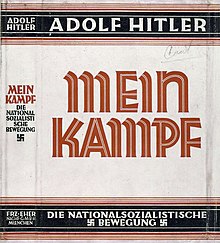 Grit jacket of 1926–1928 edition | |
| Author | Adolf Hitler |
|---|---|
| Country | German Reich |
| Language | German language |
| Subject | Autobiography Political manifesto Political philosophy |
| Publisher | Franz Eher Nachfolger GmbH |
| Publication date | 18 July 1925 |
| Published in English language | xiii October 1933 (abridged) 1939 (full) |
| Media type | Print (Hardcover and Paperback) |
| Pages | 720 |
| ISBN | 978-0395951057 (1998) trans. by Ralph Manheim |
| Dewey Decimal | 943.086092 |
| LC Form | DD247.H5 |
| Followed by | Zweites Buch |
Mein Kampf (German: [maɪn ˈkampf]; My Struggle or My Boxing) is a 1925 autobiographical manifesto by Nazi Party leader Adolf Hitler. The piece of work describes the procedure by which Hitler became antisemitic and outlines his political ideology and future plans for Frg. Volume 1 of Mein Kampf was published in 1925 and Volume 2 in 1926.[one] The book was edited first past Emil Maurice, and so by Hitler's deputy Rudolf Hess.[2] [three]
Hitler began Mein Kampf while imprisoned following his failed coup in Munich in November 1923 and a trial in Feb 1924 for high treason, in which he received the very low-cal sentence of 5 years. Although he received many visitors initially, he soon devoted himself entirely to the volume. As he continued, he realized that it would take to be a 2-volume piece of work, with the commencement volume scheduled for release in early 1925. The governor of Landsberg noted at the time that "he [Hitler] hopes the book will run into many editions, thus enabling him to fulfill his financial obligations and to defray the expenses incurred at the time of his trial."[four] [5] After wearisome initial sales, the book became a bestseller in Germany following Hitler's ascent to ability in 1933.[half dozen]
After Hitler's death, copyright of Mein Kampf passed to the state government of Bavaria, which refused to allow whatever copying or printing of the volume in Deutschland. In 2016, post-obit the expiration of the copyright held past the Bavarian state government, Mein Kampf was republished in Germany for the first time since 1945, which prompted public debate and divided reactions from Jewish groups. A team of scholars from the Institute for Contemporary History in Munich published a German-language two-volume almost 2,000-folio edition annotated with near iii,500 notes. This was followed in 2021 by a 1,000-page French edition based on the German annotated version, with about twice equally much commentary every bit text.[7]
Title
Hitler originally wanted to phone call his forthcoming volume Viereinhalb Jahre (des Kampfes) gegen Lüge, Dummheit und Feigheit (4 and a Half Years [of Struggle] Confronting Lies, Stupidity and Cowardice).[viii] Max Amann, head of the Franz Eher Verlag and Hitler's publisher, is said to have suggested[9] the much shorter "Mein Kampf" ("My Struggle").
Contents
The arrangement of chapters is as follows:
- Volume One: A Reckoning
- Chapter 1: In the House of My Parents
- Chapter 2: Years of Study and Suffering in Vienna
- Affiliate 3: Full general Political Considerations Based on My Vienna Period
- Affiliate 4: Munich
- Chapter 5: The World State of war
- Chapter half-dozen: War Propaganda
- Chapter vii: The Revolution
- Chapter 8: The Get-go of My Political Activity
- Affiliate ix: The "German language Workers' Party"
- Chapter 10: Causes of the Collapse
- Chapter 11: Nation and Race
- Chapter 12: The First Period of Development of the National Socialist High german Workers' Political party
- Volume Two: The National Socialist Movement
- Chapter ane: Philosophy and Party
- Chapter ii: The State
- Chapter 3: Subjects and Citizens
- Affiliate 4: Personality and the Formulation of the Völkisch Country
- Chapter 5: Philosophy and Organization
- Affiliate 6: The Struggle of the Early on Period – the Significance of the Spoken Word
- Affiliate vii: The Struggle with the Red Front
- Chapter 8: The Strong Human Is Mightiest Alone
- Affiliate 9: Basic Ideas Regarding the Significant and System of the Sturmabteilung
- Affiliate 10: Federalism as a Mask
- Chapter eleven: Propaganda and Organization
- Affiliate 12: The Trade-Marriage Question
- Affiliate 13: German Alliance Policy Subsequently the War
- Chapter 14: Eastern Orientation or Eastern Policy
- Chapter 15: The Right of Emergency Defense
- Conclusion
- Index
Analysis
In Mein Kampf , Hitler used the master thesis of "the Jewish peril", which posits a Jewish conspiracy to gain globe leadership.[10] The narrative describes the process by which he became increasingly antisemitic and militaristic, especially during his years in Vienna. He speaks of not having met a Jew until he arrived in Vienna, and that at commencement his mental attitude was liberal and tolerant. When he showtime encountered the antisemitic press, he says, he dismissed it as unworthy of serious consideration. Later he accustomed the same antisemitic views, which became crucial to his program of national reconstruction of Frg.
Mein Kampf has also been studied equally a work on political theory. For case, Hitler announces his hatred of what he believed to be the globe's 2 evils: Communism and Judaism.
In the volume Hitler blamed Federal republic of germany's chief woes on the parliament of the Weimar Commonwealth, the Jews, and Social Democrats, every bit well as Marxists, though he believed that Marxists, Social Democrats, and the parliament were all working for Jewish interests.[11] He announced that he wanted to completely destroy the parliamentary system, assertive information technology to be corrupt in principle, equally those who reach ability are inherent opportunists.
Antisemitism
While historians dispute the exact appointment Hitler decided to exterminate the Jewish people, few place the decision before the mid-1930s.[12] First published in 1925, Mein Kampf shows Hitler's personal grievances and his ambitions for creating a New Gild. Hitler also wrote that The Protocols of the Elders of Zion, a fabricated text which purported to betrayal the Jewish plot to control the world,[thirteen] was an authentic document. This after became a part of the Nazi propaganda effort to justify persecution and anything of the Jews.[14] [fifteen]
The historian Ian Kershaw points out that several passages in Mein Kampf are undeniably of a genocidal nature.[16] Hitler wrote "the nationalization of our masses will succeed only when, aside from all the positive struggle for the soul of our people, their international poisoners are exterminated",[17] and he suggested that, "If at the start of the war and during the war twelve or fifteen yard of these Hebrew corrupters of the nation had been subjected to poison gas, such equally had to be endured in the field by hundreds of thousands of our very best High german workers of all classes and professions, and so the sacrifice of millions at the front would not have been in vain."[xviii]
The racial laws to which Hitler referred resonate direct with his ideas in Mein Kampf . In the get-go edition, Hitler stated that the destruction of the weak and sick is far more than humane than their protection. Apart from this allusion to humane treatment, Hitler saw a purpose in destroying "the weak" in order to provide the proper space and purity for the "strong".[19]
Anti-Slavism and Lebensraum ("living space")
Hitler described that when he was in Vienna it was repugnant for him to see the mixture of races "of Czechs, Poles, Hungarians, Ruthenians (Ukranians), Serbs and Croats, and always that infection which dissolves human being society, the Jew, were all hither and there and everywhere."[20]
He likewise wrote that he viewed the Japanese victory over the Russians in the Russo-Japanese War in 1904 equally a "blow to Austrian Slavism".[21]
In the chapter "Eastern Orientation or Eastern Policy", Hitler argued that the Germans needed Lebensraum in the East, a "historic destiny" that would properly nurture the German people.[22] Hitler believed that "the organisation of a Russian land formation was not the result of the political abilities of the Slavs in Russia, just only a wonderful example of the state-forming efficacy of the German element in an inferior race."[23]
In Mein Kampf Hitler openly stated the future German expansion in the Due east, foreshadowing Generalplan Ost:
And then we National Socialists consciously depict a line beneath the foreign policy tendency of our pre-State of war period. We take upward where we bankrupt off half-dozen hundred years ago. We stop the endless German movement to the south and west, and turn our gaze toward the state in the east. At long last we break off the colonial and commercial policy of the pre-War period and shift to the soil policy of the future. If we speak of soil in Europe today, we tin primarily have in mind but Russia and her vassal border states.[24]
Hitler wrote that he was against any attempts to Germanise Slavs and criticised the previous attempts at trying to Germanise the Austrian Slavs. He likewise criticised people in pan-German movements in Germany who thought that forcing ethnic Poles living in Germany to speak the High german language would turn them into Germans; he believed that would have caused a "strange race" past its ain "inferiority" to damage the "dignity" and "dignity" of the German language nation.[25]
Popularity

Arabic edition of Mein Kampf
Although Hitler originally wrote Mein Kampf by and large for the followers of National Socialism, it grew in popularity after he rose to power. (Ii other books written by party members, Gottfried Feder's Breaking The Interest Slavery and Alfred Rosenberg'south The Myth of the Twentieth Century, accept since lapsed into comparative literary obscurity.)[26] Hitler had made virtually 1.two million Reichsmarks from the income of the book by 1933 (equivalent to €5,139,482 in 2017), when the average annual income of a teacher was virtually 4,800 Marks (equivalent to €20,558 in 2017).[26] [27] He accumulated a revenue enhancement debt of 405,500 Reichsmark (very roughly in 2015 1.1 one thousand thousand GBP, 1.four million EUR, one.5 million USD) from the auction of almost 240,000 copies before he became chancellor in 1933 (at which fourth dimension his debt was waived).[26] [27]
Hitler began to distance himself from the book after becoming chancellor of Germany in 1933. He dismissed information technology as "fantasies behind confined" that were little more than a series of manufactures for the Völkischer Beobachter , and later told Hans Frank that "If I had had any thought in 1924 that I would have go Reich chancellor, I never would have written the book."[28] Nevertheless, Mein Kampf was a bestseller in Germany during the 1930s.[29] During Hitler'south years in power, the book was in high demand in libraries and often reviewed and quoted in other publications. It was given costless to every newlywed couple and every soldier fighting at the forepart.[26] By 1939 it had sold 5.2 million copies in eleven languages.[30] Past the end of the war, about 10 million copies of the book had been sold or distributed in Germany.[ commendation needed ]
Contemporary observations
Mein Kampf , in essence, lays out the ideological program Hitler established for the German revolution, by identifying the Jews and "Bolsheviks" as racially and ideologically inferior and threatening, and "Aryans" and National Socialists as racially superior and politically progressive. Hitler's revolutionary goals included expulsion of the Jews from Greater Germany and the unification of High german peoples into i Greater Germany. Hitler desired to restore German lands to their greatest historical extent, existent or imagined.
Due to its racist content and the historical result of Nazism upon Europe during World War 2 and the Holocaust, it is considered a highly controversial book. Criticism has not come solely from opponents of Nazism. Italian Fascist dictator and Nazi ally Benito Mussolini was also critical of the volume, proverb that it was "a tedious tome that I accept never been able to read" and remarking that Hitler'southward behavior, as expressed in the book, were "little more than commonplace clichés".[31]
The German announcer Konrad Heiden, an early critic of the Nazi Party, observed that the content of Mein Kampf is essentially a political argument with other members of the Nazi Party who had appeared to be Hitler's friends, but whom he was actually denouncing in the book's content – sometimes by not even including references to them.[ citation needed ]
The American literary theorist and philosopher Kenneth Burke wrote a 1939 rhetorical analysis of the work, The Rhetoric of Hitler'south "Boxing", which revealed an underlying bulletin of ambitious intent.[32]
The American journalist John Gunther said in 1940 that compared to the autobiographies such every bit Leon Trotsky'southward My Life or Henry Adams'south The Instruction of Henry Adams, Mein Kampf was "vapid, vain, rhetorical, diffuse, prolix." However, he added that "it is a powerful and moving volume, the product of great passionate feeling". He suggested that the book wearied curious High german readers, merely its "incessant repetition of the argument, left impregnably in their minds, fecund and germinating".[33]
In March 1940, British writer George Orwell reviewed a then-recently published uncensored translation of Mein Kampf for The New English Weekly. Orwell suggested that the force of Hitler's personality shone through the often "clumsy" writing, capturing the magnetic allure of Hitler for many Germans. In essence, Orwell notes, Hitler offers simply visions of endless struggle and disharmonize in the creation of "a horrible dotterel empire" that "stretch[es] to Transitional islamic state of afghanistan or thereabouts". He wrote, "Whereas Socialism, and even capitalism in a more grudging way, have said to people 'I offer you lot a good time,' Hitler has said to them, 'I offer you struggle, danger, and expiry,' and as a event a whole nation flings itself at his feet." Orwell'southward review was written in the backwash of the 1939 Molotov–Ribbentrop Pact, when Hitler fabricated peace with USSR after more than a decade of vitriolic rhetoric and threats between the two nations; with the pact in place, Orwell believed, England was now facing a risk of Nazi attack and the United kingdom must not underestimate the appeal of Hitler's ideas.[34]
In his 1943 book The Menace of the Herd, Austrian scholar Erik von Kuehnelt-Leddihn[35] described Hitler's ideas in Mein Kampf and elsewhere as "a veritable reductio ad absurdum of 'progressive' thought"[36] and betraying "a curious lack of original thought" that shows Hitler offered no innovative or original ideas but was simply "a virtuoso of commonplaces which he may or may not repeat in the guise of a 'new discovery.'"[37] Hitler'southward stated aim, Kuehnelt-Leddihn writes, is to quash individualism in furtherance of political goals:
When Hitler and Mussolini attack the "western democracies" they insinuate that their "commonwealth" is non genuine. National Socialism envisages abolishing the difference in wealth, education, intellect, taste, philosophy, and habits past a leveling process which necessitates in turn a full control over the child and the adolescent. Every personal mental attitude volition be branded—after communist design—as "bourgeois," and this in spite of the fact that the bourgeois is the representative of the almost herdist grade in the earth, and that National Socialism is a basically bourgeois motility. In Mein Kampf , Hitler repeatedly speaks of the "masses" and the "herd" referring to the people. The German people should probably, in his view, remain a mass of identical "individuals" in an enormous sand heap or ant heap, identical even to the color of their shirts, the garment nearest to the body.[38]
In his The 2nd World State of war, published in several volumes in the late 1940s and early 1950s, Winston Churchill wrote that he felt that later Hitler's ascension to power, no other book than Mein Kampf deserved more intensive scrutiny.[39]
Later analysis
The critic George Steiner has suggested that Mein Kampf can be seen as one of several books that resulted from the crisis of German culture following Deutschland's defeat in World War I, comparable in this respect to the philosopher Ernst Bloch'south The Spirit of Utopia (1918), the historian Oswald Spengler's The Turn down of the West (1918), the theologian Franz Rosenzweig's The Star of Redemption (1921), the theologian Karl Barth's The Epistle to the Romans (1922), and the philosopher Martin Heidegger'due south Beingness and Time (1927).[40]
On translation
A number of translators accept commented on the poor quality of Hitler's use of language in writing Mein Kampf. Olivier Mannoni, who translated the 2021 French disquisitional edition, said about the original German text that information technology was "An incoherent soup, one could get one-half-mad translating information technology," and said that previous translations had corrected the linguistic communication, giving the false impression that Hitler was a "cultured man" with "coherent and grammatically correct reasoning". He added "To me, making this text elegant is a criminal offense."[7] Mannoni'due south comments are like to those made by Ralph Manheim, who did the first English-linguistic communication translation in 1943. Mannheim wrote in the foreword to the edition "Where Hitler's formulations challenge the reader's credulity I accept quoted the German original in the notes." This evaluation of the awfulness of Hitler's prose and his inability to express his opinions coherently was shared by William Southward. Schlamm, who reviewed Manheim's translation in The New York Times, writing that "at that place was not the faintest similarity to a thought and barely a trace of linguistic communication."[41]
German publication history
While Hitler was in power (1933–1945), Mein Kampf came to exist available in 3 common editions. The first, the Volksausgabe or People's Edition, featured the original cover on the dust jacket and was navy blueish underneath with a golden swastika hawkeye embossed on the encompass. The Hochzeitsausgabe , or Wedding Edition, in a slipcase with the seal of the province embossed in gold onto a parchment-like cover was given free to marrying couples. In 1940, the Tornister-Ausgabe , or Knapsack Edition, was released. This edition was a compact, but unabridged, version in a red cover and was released by the mail office, available to be sent to loved ones fighting at the front end. These three editions combined both volumes into the same book.
A special edition was published in 1939 in accolade of Hitler's 50th birthday. This edition was known as the Jubiläumsausgabe , or Anniversary Issue. It came in both nighttime blue and bright red boards with a gold sword on the cover. This work contained both volumes one and two. Information technology was considered a deluxe version, relative to the smaller and more mutual Volksausgabe .
The book could also exist purchased as a ii-volume set up during Hitler's rule, and was available in soft cover and hardcover. The soft comprehend edition contained the original cover (as pictured at the pinnacle of this article). The hardcover edition had a leather spine with cloth-covered boards. The cover and spine contained an image of three brown oak leaves.
2016 critical edition
After Hitler's death, the copyright passed to the government of Bavaria, which refused to permit it to be republished. The copyright ran out on December 31, 2015.
On 3 Feb 2010, the Found of Contemporary History (IfZ) in Munich announced plans to republish an annotated version of the text, for educational purposes in schools and universities, in 2015. The book had last been published in Germany in 1945.[42] The IfZ argued that a republication was necessary to become an administrative annotated edition by the fourth dimension the copyright ran out, which might open up the style for neo-Nazi groups to publish their own versions.[43] The Bavarian Finance Ministry building opposed the plan, citing respect for victims of the Holocaust. It stated that permits for reprints would not exist issued, at abode or abroad. This would as well apply to a new annotated edition.
At that place was disagreement about the issue of whether the republished book might be banned as Nazi propaganda. The Bavarian government emphasized that even after expiration of the copyright, "the broadcasting of Nazi ideologies will remain prohibited in Germany and is punishable under the penal code".[44] However, the Bavarian Science Minister Wolfgang Heubisch supported a critical edition, stating in 2010, "Once Bavaria's copyright expires, there is the danger of charlatans and neo-Nazis appropriating this infamous book for themselves".[43]
On 12 December 2013 the Bavarian government cancelled its financial support for an annotated edition. IfZ, which was preparing the translation, announced that it intended to proceed with publication after the copyright expired.[45] The IfZ scheduled an edition of Mein Kampf for release in 2016.[46]
Richard Verber, vice-president of the Board of Deputies of British Jews, stated in 2015 that the board trusted the academic and educational value of republishing. "We would, of course, exist very wary of whatever endeavor to glorify Hitler or to scoff the Holocaust in any mode", Verber declared to The Observer. "But this is not that. I do empathize how some Jewish groups could be upset and nervous, but it seems it is being done from a historical point of view and to put information technology in context".[47]
The annotated edition of Mein Kampf was published in Germany in Jan 2016 and sold out within hours on Amazon's German site. The ii-volume edition included about 3,500 notes, and was almost two,000 pages long.[48] Usually, according to Gerhard Weinberg, the data in the annotated edition that accompanies a affiliate is mostly nearly when the chapter was written, though "in some cases" there is commentary on the nature and statement of the chapter.[49]
The book's publication led to public debate in Federal republic of germany, and divided reactions from Jewish groups, with some supporting, and others opposing, the determination to publish.[29] German officials had previously said they would limit public access to the text amid fears that its republication could stir neo-Nazi sentiment.[50] Some bookstores stated that they would not stock the book. Dussmann, a Berlin bookstore, stated that one re-create was available on the shelves in the history section, simply that it would not exist advertised and more copies would be available just on order.[51] Past January 2017, the High german annotated edition had sold over 85,000 copies.[52]
Gerhard Weinberg wrote a generally positive review of the annotated edition, praising the choice to include not just editors' comments simply besides changes of the original text. He said that notes such equally those of chapters eight and 9 "volition be extremely helpful" well-nigh the situation in the time of Hitler's entry into politics, and lauded the notes to chapter xi ("People and Race") equally "extensive and very helpful" as well. On the negative side, Weinberg noted that the editors make a false correction at one signal; that they miss an informative book on High german atrocities during Earth War I; that they include a survey of Nazi membership too late; and that all of his own work on Hitler goes unmentioned in the bibliography.[49]
English translations
Ever since the early 1930s, the history of Adolf Hitler's Mein Kampf in English has been complicated and has been the occasion for controversy.[53] [54] No fewer than 4 full translations were completed earlier 1945, equally well as a number of extracts in newspapers, pamphlets, government documents and unpublished typescripts. Not all of these had official approval from his publishers, Eher Verlag. Since the war, the 1943 Ralph Manheim translation has been the almost popular published translation, though other versions have connected to circulate.
Current availability
At the time of his suicide, Hitler'southward official place of residence was in Munich, which led to his entire manor, including all rights to Mein Kampf , changing to the ownership of the country of Bavaria. The government of Bavaria, in agreement with the federal government of Frg, refused to let any copying or printing of the volume in Germany. It also opposed copying and printing in other countries, just with less success. As per German copyright police force, the unabridged text entered the public domain on ane January 2016, upon the expiration of the agenda year lxx years afterward the author'south decease.[55]
Owning and buying the book in Germany is not an offence. Trading in old copies is lawful likewise, unless it is washed in such a fashion as to "promote hatred or war." In particular, the unmodified edition is not covered past §86 StGB that forbids broadcasting of means of propaganda of unconstitutional organizations, since it is a "pre-ramble work" and as such cannot be opposed to the costless and democratic basic guild, according to a 1979 conclusion of the Federal Court of Justice of Germany.[56] Most German libraries bear heavily commented and excerpted versions of Mein Kampf . In 2008, Stephan Kramer, secretarial assistant-full general of the Central Council of Jews in Germany, not only recommended lifting the ban, but volunteered the assist of his system in editing and annotating the text, saying that information technology is time for the book to be made available to all online.[57]
A multifariousness of restrictions or special circumstances apply in other countries.
French republic
In 1934, the French government unofficially sponsored the publication of an unauthorized translation. It was meant as a alert and included a disquisitional introduction by Marshal Lyautey ("Every Frenchman must read this book"). It was published by far-right publisher Fernand Sorlot in an agreement with the activists of LICRA who bought 5000 copies to exist offered to "influential people"; nevertheless, near of them treated the book as a casual gift and did non read information technology.[58] The Nazi regime unsuccessfully tried to take it forbidden. Hitler, as the writer, and Eher-Verlag, his German publisher, had to sue for copyright infringement in the Commercial Court of France. Hitler's lawsuit succeeded in having all copies seized, the print broken up, and having an injunction against booksellers offering any copies. However, a large quantity of books had already been shipped and stayed bachelor undercover by Sorlot.[59]
In 1938, Hitler licensed for France an authorized edition by Fayard, translated by François Dauture and Georges Blond, lacking the threatening tone against France of the original. The French edition was 347 pages long, while the original championship was 687 pages, and it was titled Ma doctrine ("My doctrine").[60]
After the war, Fernand Sorlot re-edited, re-issued, and continued to sell the work, without permission from the state of Bavaria, to which the author'southward rights had defaulted.
In the 1970s, the ascent of the farthermost correct in France along with the growing of Holocaust denial works, placed the Mein Kampf nether judicial lookout and in 1978, LICRA entered a complaint in the courts confronting the publisher for inciting antisemitism. Sorlot received a "substantial fine" simply the court also granted him the right to proceed publishing the work, provided sure warnings and qualifiers accompany the text.[59]
On 1 January 2016, 70 years after the author's death, Mein Kampf entered the public domain in France.[59]
A new edition was published in 2017 by Fayard, now function of the Groupe Hachette, with a critical introduction, just as the edition published in 2018 in Germany past the Institut für Zeitgeschichte , the Institute of Gimmicky History based in Munich.[59]
In 2021, a i,000 folio disquisitional edition, based on the German edition of 2016, was published in French republic. Titled Historiciser le mal: Une édition critique de Mein Kampf ("Historicizing Evil: A Critical Edition of Mein Kampf"), with nigh twice as much commentary equally text, it was edited by Florent Brayard and Andraes Wirsching, translated by Olivier Mannoni, and published by Fayard. The impress run was deliberately kept modest at 10,000 bachelor merely by special order, with copies set bated for public libraries. Gain from the sale of the edition are earmarked for the Auschwitz-Birkenau Foundation. Some critics who had objected in accelerate to the edition'due south publication had fewer objections upon publication. One historian noted that there were and so many annotations that Hitler'southward text had become "secondary."[seven]
India
Since its first publication in Bharat in 1928, Mein Kampf has gone through hundreds of editions and sold over 100,000 copies.[61] [62] Mein Kampf was translated into various Indian languages such as Hindi, Gujarati, Malayalam, Tamil and Bengali.[63]
Israel
An extract of Mein Kampf in Hebrew was first published in 1992 past Akadamon with 400 copies.[64] So the complete translation of the book in Hebrew was published by the Hebrew Academy of Jerusalem in 1995. The translator was Dan Yaron, a Vienna-born retired teacher and Holocaust survivor.[65]
Republic of latvia
On 5 May 1995 a translation of Mein Kampf released by a small Latvian publishing house Vizītkarte began appearing in bookstores, provoking a reaction from Latvian authorities, who confiscated the approximately 2,000 copies that had fabricated their fashion to the bookstores and charged director of the publishing house Pēteris Lauva with offences under anti-racism constabulary.[66] Currently the publication of Mein Kampf is forbidden in Republic of latvia.[67] [ boosted commendation(s) needed ]
In Apr 2018 a number of Russian-linguistic communication news sites (Baltnews, Zvezda, Sputnik, Komsomolskaya Pravda and Komprava among others) reported that Adolf Hitler had allegedly get more popular in Latvia than Harry Potter, referring to a Latvian online book trading platform ibook.lv, where Mein Kampf had appeared at the No. one position in "The Most Current Books in 7 Days" list.[68] [69] [70]
In research done past Polygraph.info who called the claim "false", ibook.lv was only the 878th almost pop website and 149th nigh popular shopping site in Latvia at the time, according to Alexa Cyberspace. In addition to that, the website only had iv copies on sale by individual users and no users wishing to buy the book.[69] Owner of ibook.lv pointed out that the volume list is not based on actual deals, only rather folio views, of which 70% in the instance of Mein Kampf had come from bearding and unregistered users she believed could be fake users.[70] Ambassador of Latvia to the Russia Māris Riekstiņš responded to the story past tweeting "everyone, who wishes to know what books are actually bought and read in Latvia, are advised to address the largest book stores @JanisRoze; @valtersunrapa; @zvaigzneabc".[68] The BBC also acknowledged the story was fake news, adding that in the final three years Mein Kampf had been requested for borrowing for only 139 times across all libraries in Latvia, in comparison with around 25,000 requests for books about Harry Potter.[lxx]
Netherlands
In holland Mein Kampf was not bachelor for auction for years following World War Two.[71] [72] Sale has been prohibited since a court ruling in the 1980s. In September 2018, however, Dutch publisher Prometheus officially released an bookish edition of the 2016 German translation with comprehensive introductions and annotations by Dutch historians.[73] It marks the first time the volume is widely available to the general public in the Netherlands since World War Ii.
Romania
On 20 April 1993, nether the sponsorship of the vice-president of the Democratic Agrarian Political party of Romania, Sibiu-based Pacific publishers began issuing a Romanian edition of Mein Kampf. The local regime promptly banned the auction and confiscated the copies, citing Article 166 of the Penal Code. Nevertheless, the ban was overturned on entreatment by the Prosecutor General on 27 May 1993. Chief Rabbi Moses Rosen protested, and on 10 July 1993 President Ion Iliescu asked the Prosecutor General in writing to reinstate the ban of further printing and have the book withdrawn from the market. On 8 November 1993, the Prosecutor General rebuffed Iliescu, stating that the publication of the book was an act of spreading information, not conducting fascist propaganda. Although Iliescu deplored this answer "in strictly judicial terms", this was the end of the matter.[74] [75]
Russia
In the Soviet Matrimony, the publication "Mein Kampf" appeared one of the first in 1933, translated by Grigory Zinoviev.[76] In the Russian Federation, Mein Kampf has been published at least three times since 1992; the Russian text is too available on websites. In 2006 the Public Sleeping room of Russian federation proposed banning the volume. In 2009 St. Petersburg's co-operative of the Russian Ministry of Internal Affairs requested to remove an annotated and hyper-linked Russian translation of the book from a historiography website.[77] [78] [79] On thirteen Apr 2010, it was announced that Mein Kampf is outlawed on grounds of extremism promotion.[eighty]
Sweden
Mein Kampf has been reprinted several times since 1945; in 1970, 1992, 2002 and 2010. In 1992 the Government of Bavaria tried to stop the publication of the book, and the instance went to the Supreme Court of Sweden which ruled in favour of the publisher, stating that the book is protected by copyright, simply that the copyright holder is unidentified (and non the State of Bavaria) and that the original Swedish publisher from 1934 had gone out of business organisation. It therefore refused the Government of Bavaria's claim.[81] The only translation changes came in the 1970 edition, just they were only linguistic, based on a new Swedish standard.[ citation needed ]
Turkey
Mein Kampf (Turkish: Kavgam) was widely bachelor and growing in popularity in Turkey, fifty-fifty to the point where it became a bestseller, selling up to 100,000 copies in just ii months in 2005. Analysts and commentators believe the popularity of the book to be related to a rise in nationalism and anti-U.S. sentiment. İvo Molinas of Şalom stated this was a result of "what is happening in the Heart East, the Israeli-Palestinian problem and the war in Iraq."[82] Doğu Ergil, a political scientist at Ankara University, said both far-right ultranationalists and extremist Islamists had plant common footing – "non on a common agenda for the future, just on their anxieties, fears and hate".[83]
United States
In the United States, Mein Kampf tin exist plant at many community libraries and can be bought, sold and traded in bookshops.[84] The U.S. government seized the copyright in September 1942[85] during the Second Globe State of war under the Trading with the Enemy Human activity and in 1979, Houghton Mifflin, the U.Southward. publisher of the volume, bought the rights from the government pursuant to 28 CFR 0.47.[86] More than than 15,000 copies are sold a twelvemonth.[84] In 2016, Houghton Mifflin Harcourt reported that it was having difficulty finding a clemency that would accept profits from the sales of its version of Mein Kampf , which it had promised to donate.[87]
Online availability
In 1999, the Simon Wiesenthal Center documented that the volume was available in Germany via major online booksellers such as Amazon and Barnes & Noble. After a public outcry, both companies agreed to terminate those sales to addresses in Germany.[88] In March 2020 Amazon banned sales of new and second-paw copies of Mein Kampf , and several other Nazi publications, on its platform.[89] The book remains available on Barnes and Noble'due south website.[xc] It is likewise available in diverse languages, including German, at the Internet Archive.[91] One of the get-go consummate English translations was published past James Vincent Murphy in 1939.[92] The Murphy translation of the book is freely available on Project Gutenberg Australia.[93]
Sequel
After the political party'southward poor showing in the 1928 elections, Hitler believed that the reason for his loss was the public'due south misunderstanding of his ideas. He and then retired to Munich to dictate a sequel to Mein Kampf to expand on its ideas, with more focus on foreign policy.
Only two copies of the 200-folio manuscript were originally made, and only one of these was ever fabricated public. The document was neither edited nor published during the Nazi era and remains known every bit Zweites Buch , or "Second Book". To go along the document strictly secret, in 1935 Hitler ordered that information technology exist placed in a safe in an air raid shelter. It remained there until being discovered by an American officer in 1945.
The authenticity of the certificate plant in 1945 has been verified by Josef Berg, a former employee of the Nazi publishing house Eher Verlag, and Telford Taylor, a onetime brigadier general of the United States Army Reserve and Chief Counsel at the Nuremberg state of war-crimes trials.
In 1958, the Zweites Buch was found in the athenaeum of the U.s.a. by American historian Gerhard Weinberg. Unable to find an American publisher, Weinberg turned to his mentor – Hans Rothfels at the Institute of Contemporary History in Munich, and his associate Martin Broszat – who published Zweites Buch in 1961. A pirated edition was published in English in New York in 1962. The showtime administrative English language edition was non published until 2003 (Hitler's Second Book: The Unpublished Sequel to Mein Kampf, ISBN 1-929631-16-ii).
Meet too
- Berlin Without Jews, a dystopian satirical novel nearly German antisemitism, published in the same yr as Mein Kampf
- Generalplan Ost, Hitler's "new club of ethnographical relations"
- Ich Kämpfe
- Gustave Le Bon, a primary influence of this book and crowd psychology
- Listing of books banned by governments
- LTI – Lingua Tertii Imperii
- Mein Kampf in Arabic
- The Myth of the Twentieth Century
- Ukrainian military doctrine
References
Notes
- ^ Mein Kampf ("My Struggle"), Adolf Hitler (originally 1925–1926), Reissue edition (fifteen September 1998), Publisher: Mariner Books, Language: English, paperback, 720 pages, ISBN 978-1495333347
- ^ Shirer 1960, p. 85.
- ^ Robert G.L. Waite, The Psychopathic God: Adolf Hitler, Basic Books, 1977, pp. 237–243
- ^ Heinz, Heinz (1934). Germany'south Hitler. Hurst & Blackett. p. 191.
- ^ Payne, Robert (1973). The Life and Death of Adolf Hitler. Popular Library. p. 203.
- ^ Shirer 1960, pp. 80–81.
- ^ a b c Bredeen, Aurelien (June 2, 2021) "Hitler's 'Mein Kampf' Gets New French Edition, With Each Lie Annotated" The New York Times
- ^ Bullock 1999, p. 121.
- ^ Richard Cohen. "Estimate Who'due south on the Backlist". The New York Times. 28 June 1998. Retrieved 24 April 2008.
- ^ "Mein Kampf – The Text, its Themes and Hitler's Vision", History Today
- ^ "Mein Kampf". Internet Annal. 1941.
- ^ Browning, Christopher R. (2003). Initiating the Final Solution: The Fateful Months of September–Oct 1941. Washington, D.C.: United states of america Holocaust Memorial Museum, Heart for Avant-garde Holocaust Studies. p. 12. OCLC 53343660.
- ^ Graves, Philip (1921). The truth about 'The Protocols': a literary forgery (pamphlet) (articles drove). The Times of London. Archived from the original on 10 May 2013.
- ^ Hitler, Adolf. "11: Nation and Race". Mein Kampf. Vol. I. pp. 307–308.
- ^ Nora Levin, The Holocaust: The Destruction of European Jewry 1933–1945
- ^ Ian Kershaw, Hitler 1889–1936 Hubris (1999), p. 258
- ^ Adolf Hitler, Mein Kampf, Volume 1 – A Reckoning, Affiliate XII: The Beginning Period of Evolution of the National Socialist German Workers' Political party
- ^ Adolf Hitler, Mein Kampf, Volume Two – A Reckoning, Affiliate Xv: The Right of Emergency Defense, p. 984, quoted in Yahlil, Leni (1991). "two. Hitler Implements Twentieth-Century Anti-Semitism". The Holocaust: The Fate of European Jewry, 1932–1945. Oxford University Press. p. 51. ISBN978-0-19-504523-9. OCLC 20169748. Retrieved 9 January 2016.
- ^ A. Hitler. Mein Kampf (Munich: Franz Eher Nachfolger, 1930), p. 478
- ^ Joachim Fest, Hitler, p. 60
- ^ Francisco Bethencourt, Racisms: From the Crusades to the Twentieth Century, p. 325
- ^ "Hitler'southward expansionist aims > Professor Sir Ian Kershaw > WW2History.com". ww2history.com.
- ^ Adolf Hitler, Mein Kampf, Eastern Orientation or Eastern policy
- ^ Joachim C. Fest (2013). Hitler. Houghton Mifflin Harcourt. p. 216. ISBN978-0-544-19554-seven.
- ^ Richard Weikart, Hitler'south Ethnic, p. 73
- ^ a b c d "Mythos Ladenhüter" Spiegel Online
- ^ a b "Hitler dodged taxes, expert finds" BBC News
- ^ Timothy Due west. Ryback (6 July 2010). Hitler'south Private Library: The Books that Shaped his Life. Random Firm. pp. 92–93. ISBN978-i-4090-7578-3.
- ^ a b "High demand for reprint of Hitler's Mein Kampf takes publisher by surprise". The Guardian. 8 January 2016.
- ^ "Mein Kampf work by Hitler". Encyclopædia Britannica. Final updated 19 February 2014. Retrieved 21 May 2015 from http://www.britannica.com/EBchecked/topic/373362/Mein-Kampf
- ^ Smith, Denis Mack. 1983. Mussolini: A Biography. New York: Vintage Books. p. 172. London: Paladin, p. 200
- ^ Uregina.ca Archived 25 November 2011 at the Wayback Machine
- ^ Gunther, John (1940). Inside Europe. New York: Harper & Brothers. p. 31.
- ^ Orwell, George. "Mein Kampf" review, reprinted in The Collected Essays, Journalism and Letters of George Orwell, Vol ii., Sonia Orwell and Ian Angus, eds., Harourt Brace Jovanovich 1968
- ^ Francis Stuart Campbell, pen name of Erik von Kuehnelt-Leddihn (1943), Menace of the Herd, or, Procrustes at Big, Milwaukee, WI: The Bruce Publishing Company
- ^ Kuehnelt-Leddihn, p. 159
- ^ Kuehnelt-Leddihn, p. 201
- ^ Kuehnelt-Leddihn, pp. 202–203
- ^ Winston Churchill: The 2nd World State of war. Volume ane, Houghton Mifflin Books 1986, Southward. 50. "Here was the new Koran of organized religion and state of war: turgid, verbose, shapeless, just pregnant with its message."
- ^ Steiner, George (1991). Martin Heidegger. Chicago: The University of Chicago Press. pp. vii–eight. ISBN0-226-77232-2.
- ^ Schlamm, William Southward. (October 17, 1943) "German Best Seller; MEIN KAMPF. By Adolf Hitler. Translated by Ralph Manheim. 694 pp. Boston: Houghton Mifflin Company. $3.50." The New York Times
- ^ "'Mein Kampf' to run across its kickoff post-WWII publication in Germany". The Independent. London. 6 February 2010. Archived from the original on 12 February 2010.
- ^ a b Juergen Baetz (five February 2010). "Historians Hope to Publish 'Mein Kampf' in Germany". The Seattle Times.
- ^ Kulish, Nicholas (4 February 2010). "Rebuffing Scholars, Germany Vows to Keep Hitler Out of Impress". The New York Times.
- ^ "Bavaria abandons plans for new edition of Mein Kampf". BBC News. 12 December 2013.
- ^ Alison Smale (1 December 2015). "Scholars Unveil New Edition of Hitler'due south 'Mein Kampf'". The New York Times.
- ^ Vanessa Thorpe (26 Dec 2015). "British Jews give wary blessing to the return of Hitler's Mein Kampf". The Guardian.
- ^ Eddy, Melissa (8 January 2016). "'Mein Kampf,' Hitler's Manifesto, Returns to German Shelves". The New York Times . Retrieved 8 Jan 2016.
- ^ a b Weinberg, Gerhard Fifty. (25 April 2017). "Hitler, Mein Kampf: Eine kritische Edition Edited by Christian Hartmann, Thomas Vordermayer, Othmar Plöckinger, Roman Töppel, and Edith Raim, et al". academic.oup.com . Retrieved 27 March 2022.
- ^ "Copyright of Adolf Hitler'south Mein Kampf expires". BBC News. January 2016.
- ^ "Mein Kampf hits stores in tense Deutschland". BBC News. viii Jan 2016.
- ^ "The annotated version of Hitler'southward 'Mein Kampf' is a hitting in Federal republic of germany". Concern Insider.
- ^ "HOUGHTON-MIFFLIN, BEWARE!". The Sentinel. 14 September 1933.
- ^ "Hitler Aberration". The Sentinel. 8 June 1939.
- ^ § 64 Allgemeines, High german Copyright Law. The copyright has been relinquished for the Dutch and Swedish editions and some English language ones (though not in the U.Due south., see below).
- ^ Judgement of 25 July 1979 – three StR 182/79 (S); BGHSt 29, 73 ff.
- ^ "Jewish Leader Urges Book Ban Finish", Dateline World Jewry, Earth Jewish Congress, July/August 2008.
- ^ Bleustein-Blanchet, Marcel (1990). Les mots de ma vie [The words of my life] (in French). Paris: Robert Laffont. p. 271. ISBN2221067959. .
- ^ a b c d Braganca, Manu (10 June 2016). "La curieuse histoire de Mein Kampf en version française" [The curious history of Mein Kampf in the french version]. Le Point (in French). Retrieved 4 June 2019.
- ^ Barnes, James J.; Barnes, Patience P. (2008). Hitler's Mein Kampf in Britain and America: A Publishing History 1930–39. United Kingdom: Cambridge University Press. p. 271. ISBN978-0521072670. .
- ^ "Archiv – 33/2013 – Dschungel – Über dice Wahrnehmung von Faschismus und Nationalsozialismus in Indien". Jungle-earth.com.
- ^ Gupta, Suman (17 November 2012). "On the Indian Readers of Hitler's Mein Kampf" (PDF). Economical & Political Weekly. Archived from the original (PDF) on 9 May 2013. Retrieved seven February 2021.
- ^ Noman, Natasha (12 June 2015). "The Strange History of How Hitler's 'Mein Kampf' Became a Bestseller in India". Mic . Retrieved 7 Feb 2021.
- ^ "Israeli Publisher Problems Parts Of 'Mein Kampf' in Hebrew". The New York Times. 5 August 1992.
- ^ "Hebrew Translation Of Hitler Volume To Be Printed". The Spokesman-Review. 16 February 1995. Archived from the original on 7 February 2021.
- ^ "Latvia Calls Halt to Sale of 'Mein Kampf'". Los Angeles Times. 21 May 1995. Retrieved 9 October 2019.
- ^ Bowcott, Owen (18 June 2001). "Charity returns £250,000 royalties for Hitler's credo". The Guardian . Retrieved 9 October 2019.
Portugal, Sweden, Norway, Republic of latvia, Switzerland and Hungary have also all forbidden publication.
- ^ a b Sprūde, Viesturs. "Fake News: In Latvia Hitler's "Mein Kampf" is more popular than Harry Potter". Museum of the Occupation of Latvia. Retrieved 9 Oct 2019.
- ^ a b "Sputnik and Zvezda Falsely Claim Hitler'south Mein Kampf is more than popular than Harry Potter in Republic of latvia". Polygraph.info. 13 April 2018. Retrieved 9 October 2019.
- ^ a b c "Exercise Latvians actually read more than Hitler than Harry Potter?". BBC News. 9 October 2019. Retrieved 9 October 2019.
- ^ "Store owner cleared of spreading hatred for selling Mein Kampf – DutchNews.nl". 14 Feb 2017.
- ^ "metronieuws.nl cookie consent". tmgonlinemedia.nl.
- ^ "De wetenschappelijke editie van Mein Kampf – Uitgeverij Prometheus". Uitgeverij Prometheus (in Dutch). 23 August 2018. Retrieved five September 2018.
- ^ Yoram Dinstein, Martinus Nijhoff Publishers, 1 iun. 1996, Israel Yearbook on Human Rights: 1995, pp. 414-415
- ^ Solomon, Daniela (fourteen December 2015). "Cum a fost tipărit și ars la Sibiu volumul 'Mein Kampf' al lui Hitler". Turnul Sfatului. Retrieved 26 February 2022.
- ^ Alexander Watlin. "Mein Kampf". What to do? Gefter (December 24, 2014).
- ^ "A well-known historiography web site close down over publishing Hitler'southward book", Newsru.com, 8 July 2009.
- ^ "Моя борьба". 2009. Retrieved 8 July 2009.
- ^ Adolf Hitler, annotated and hyper-linked ed. by Vyacheslav Rumyantsev, archived from the original 12 Feb 2008; an abridged version remained intact.
- ^ "Radio Netherlands Worldwide". Archived from the original on 7 June 2011. Retrieved 27 March 2010.
- ^ "Hägglunds förlag". Hagglundsforlag.se. Archived from the original on 31 March 2012.
- ^ Smith, Helena (29 March 2005). "Mein Kampf sales soar in Turkey". The Guardian. London.
- ^ "Hitler book bestseller in Turkey". BBC News. 18 March 2005.
- ^ a b Pascal, Julia (25 June 2001). "Unbanning Hitler". New Statesman. Archived from the original on 29 September 2018. Retrieved 29 September 2018.
- ^ "The Milwaukee Periodical" – via Google News Archive Search. [ dead link ]
- ^ 28 CFR 0.47
- ^ "Boston publisher grapples with 'Mein Kampf' profits" The Boston World Retrieved 3 May 2016.
- ^ Beyette, Beverly (five Jan 2000). "Is hate for sale?". Los Angeles Times.
- ^ Waterson, Jim (16 March 2020). "Amazon bans sale of most editions of Adolf Hitler'southward Mein Kampf". The Guardian.
- ^ "Mein Kampf". Barnes & Noble. Retrieved 20 March 2020.
- ^ "Cyberspace Archive Search: Mein Kampf". archive.org.
- ^ Spud, John (xiv January 2015). "Why did my granddad translate Mein Kampf?". BBC News. Retrieved 19 May 2018.
- ^ "Mein Kampf – Project Gutenberg Australia".
Bibliography
- Bullock, Alan (1999) [1952]. Hitler: A Study in Tyranny. New York: Konecky & Konecky. ISBN978-1-56852-036-0.
- Shirer, William L. (1960). The Ascent and Fall of the Tertiary Reich. New York: Simon and Schuster.
Further reading
-
- Hitler
- Hitler, A. (1925). Mein Kampf, Ring 1, Verlag Franz Eher Nachfahren, München. (Volume 1, publishing company Fritz Eher and descendants, Munich).
- Hitler, A. (1927). Mein Kampf, Band two, Verlag Franz Eher Nachfahren, München. (Book 2, after 1930 both volumes were merely published in one book).
- Hitler, A. (1935). Zweites Buch (trans.) Hitler'southward 2d Book: The Unpublished Sequel to Mein Kampf by Adolf Hitler. Enigma Books. ISBN 978-1-929631-61-two.
- Hitler, A. (1945). My Political Attestation. Wikisource Version.
- Hitler, A. (1945). My Individual Will and Testament. Wikisource Version.
- Hitler, A., et al. (1971). Unmasked: two confidential interviews with Hitler in 1931. Chatto & Windus. ISBN 0-7011-1642-0.
- Hitler, A., et al. (1974). Hitler'due south Messages and Notes. Harper & Row. ISBN 0-06-012832-one.
- Hitler, A., et al. (2008). Hitler's Table Talk. Enigma Books. ISBN 978-1-929631-66-7.
- A. Hitler. Mein Kampf, Munich: Franz Eher Nachfolger, 1930
- A. Hitler, Außenpolitische Standortbestimmung nach der Reichtagswahl Juni–Juli 1928 (1929; outset published as Hitlers Zweites Buch, 1961), in Hitler: Reden, Schriften, Anordnungen, Februar 1925 bis Januar 1933, Vol IIA, with an introduction by G. L. Weinberg; G. 50. Weinberg, C. Hartmann and K. A. Lankheit, eds (Munich: K. Chiliad. Saur, 1995)
- Christopher Browning, Initiating the Final Solution: The Fateful Months of September–October 1941, Miles Lerman Center for the Study of Jewish Resistance, U.S. Holocaust Memorial Museum (Washington, D.C.: USHMM, 2003).
- Gunnar Heinsohn, "What Makes the Holocaust a Uniquely Unique Genocide", Journal of Genocide Enquiry, vol. 2, no. iii (2000): 411–430.
- Eberhard Jäckel/Ellen Latzin, Mein Kampf (Adolf Hitler, 1925/26), published 11 May 2006, English language version published 3 March 2020; in: Historisches Lexikon Bayerns
-
- Others
- Barnes, James J.; Barnes, Patience P. (1980). Hitler Mein Kampf in Britain and America. Cambridge: Cambridge University Press.
- Jäckel, Eberhard (1972). Hitler's Weltanschauung: A Design For Power. Middletown, Conn.: Wesleyan University Printing. ISBN0-8195-4042-0.
- Hauner, Milan (1978). "Did Hitler Desire Globe Domination?". Periodical of Gimmicky History. Journal of Gimmicky History, Vol. 13, No. 1. 13 (one): 15–32. doi:10.1177/002200947801300102. JSTOR 260090. S2CID 154865385.
- Hillgruber, Andreas (1981). Germany and the Ii Globe Wars. Cambridge, Mass.: Harvard University Press. ISBN0-674-35321-8.
- Littauer-Apt, Rudolf M. (1939–1940). "The Copyright in Hitler's 'Mein Kampf'". Copyright. 5: 57 et seq.
- Michaelis, Meir (1972). "World Power Status or Earth Dominion? A Survey of the Literature on Hitler's 'Programme of World Dominion' (1937–1970)". The Historical Journal. fifteen (ii): 331–360. doi:10.1017/s0018246x00002624. JSTOR 2638127.
- Rich, Norman (1973). Hitler's State of war Aims. New York: Norton. ISBN0-393-05454-3.
- Trevor-Roper, Hugh (1960). "Hitlers Kriegsziele". Vierteljahrshefte für Zeitgeschichte. 8: 121–133. ISSN 0042-5702.
- Zusak, Markus (2006). The Book Thief. New York: Knopf. ISBN0-375-83100-two.
External links
- A review of Mein Kampf by George Orwell, first published in March 1940
- Hitler's Mein Kampf Seen As Cocky-Help Guide For Bharat's Business concern Students The Huffington Post, 22 April 2009
- Hitler book bestseller in Turkey, BBC News, 18 March 2005
- Protest at Czech Mein Kampf, BBC News, 5 June 2000
- Mein Kampf a hitting on Dhaka streets, BBC News, 27 November 2009
- Hitler's book stirs anger in Republic of azerbaijan, BBC News, ten December 2004
- "Mein Kampf:" - Adolf Hitler's book Archived nineteen August 2019 at the Wayback Machine, a Deutsche Welle television documentary covering the history of the book through gimmicky media and interviews with experts and High german citizens, narrated in English language, 15 August 2019
Online versions of Mein Kampf
-
- German language
- 1936 edition (172.-173. printing) in High german Fraktur script (71.4 Mb)
- 1943 edition (3.eight MB)
- High german version as an audiobook, human-read (27h 17m, 741 Mb)
-
- English language
- 1940 Mein Kampf: Performance Sea Lion Edition at archive.org
- Potato translation at Gutenberg
- Murphy translation at greatwar.nl (pdf, txt)
- Consummate Dugdale abridgment at archive.org
- 1939 Reynal and Hitchcock translation at archive.org.
Source: https://en.wikipedia.org/wiki/Mein_Kampf
0 Response to "Book Review When America Turned Reckoning With 1968"
Post a Comment