ââåage of Uncertaintyã¢ââ Reflected in the Arts of This Era?
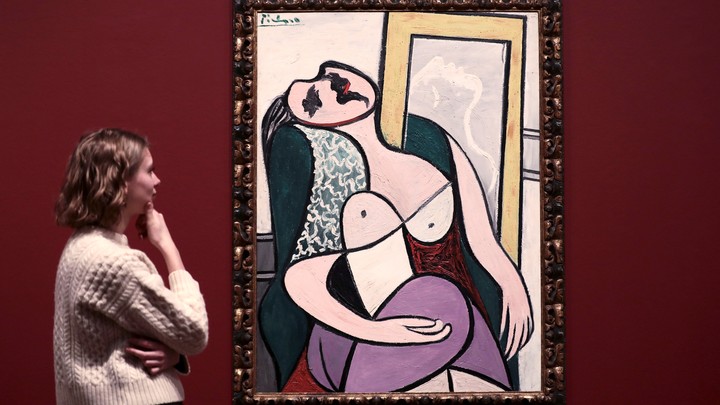
Visual art tells yous what era it comes from. During dissimilar historical periods, certain styles, motifs, and color palettes, dominate—so even if experts don't know the artist and origin of a piece, they can often pivot it to a particular moment in time. In today's effect, we focus on two very different schools of art that flourished in the early 20th century. An Atlantic video producer shows usa how she created a 1930s-inspired animation, and Karen Yuan reports on how Picasso influenced the artistic landscape when his work first arrived in the United states. Finally, we'll leave y'all with a question: There are certain characteristics that permit us to date the art of the past, but volition we keep to be able to date the fine art of the future?
—Caroline Kitchener
How to Breathing Like It's 1932
Atlantic animator Caitlin Cadieux explains her process for creating '30s-inspired art.
As function of our Atlantic Athenaeum project, I blithe an essay by Helen Keller: "Put Your Hubby in the Kitchen," published in The Atlantic in Baronial, 1932. Keller'south story was a stern rebuke of the (predominantly male) "captains of industry" of her day, blaming them for wasteful business practices. Keller posits a businessman named Mr. Jones, drawn from overwork and overproduction, who agrees to swap places with his homemaker wife. She argues that men would acquire far ameliorate business sense past taking on the household management tasks that traditionally cruel to women.
I wanted to adapt the piece in the way of cartoons from that time catamenia, which presented some unique challenges. Animations in the 1930s were painstakingly created by hand using traditional materials, rather than the digital tools nosotros use today. They also included some problematic representations of gender. You tin watch the video to run across where I ended upwardly. Here'south what I learned in getting in that location.
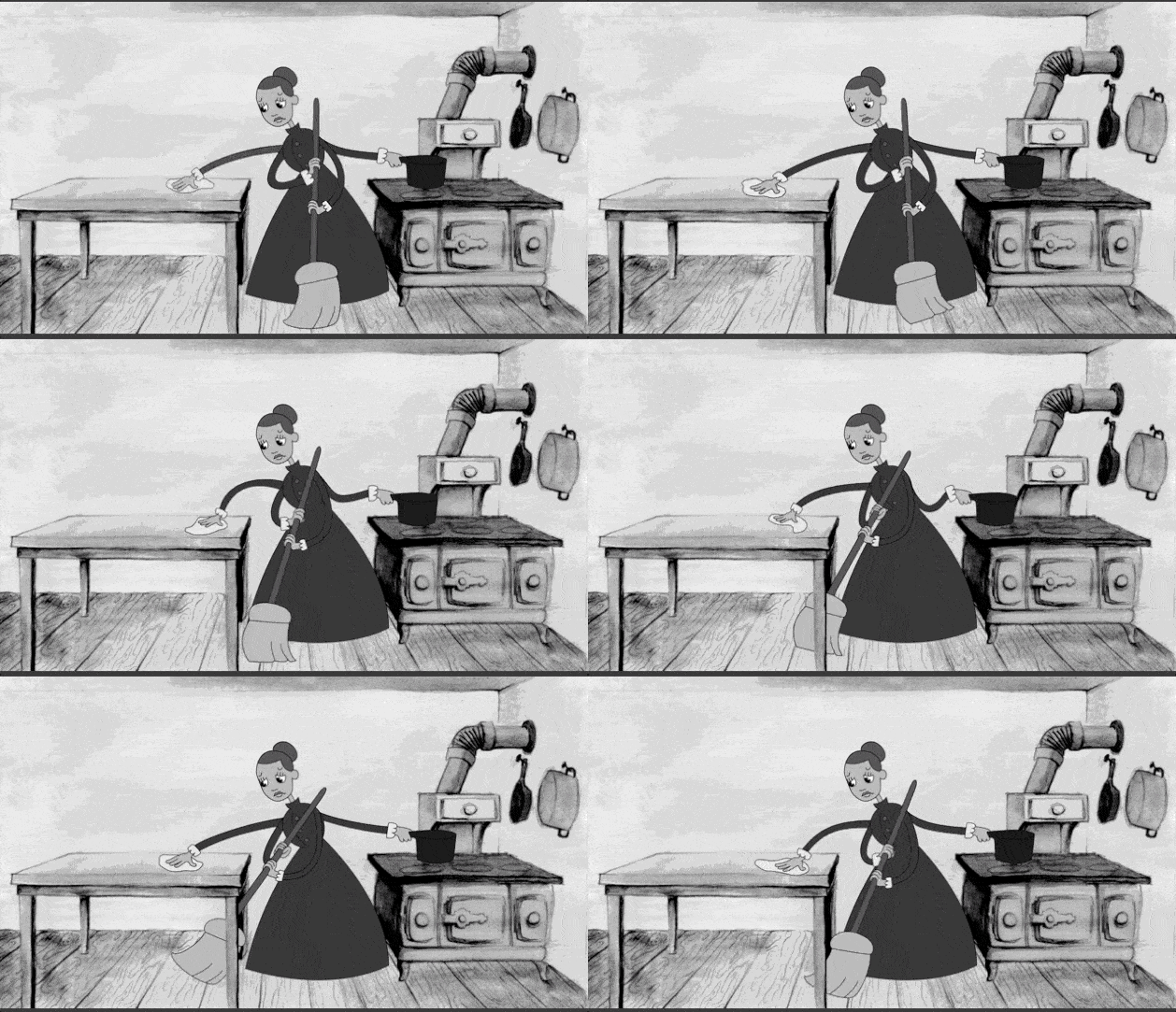
- Exercise your (history) homework
The tone and voice of Keller'southward essay struck me as very similar to a public service announcement–mode video from the aforementioned period. For reference, I watched several PSAs, such as this advertizing past the federal government promoting the New Deal, and this condom warning nearly the dangers of gasoline in dress laundering. The fact that these PSAs were invariably narrated by men immune us to set upwards a dissimilarity with Keller's feminist viewpoint. (The Atlantic's own Alex Wagner provided the voiceover for u.s.a.. Married to former White House chef, Sam Kass, Alex was a peculiarly fitting reader for "Put Your Husband in the Kitchen"!)
Because Atlantic Athenaeum is an animated historical series, it made sense to draw on the visual sensibilities of this essay's era, the 1930s. In 1928, with the introduction of audio cartoons and Walt Disney's rising to prominence, animation entered a Golden Age. Cartoons at the fourth dimension frequently featured slapstick comedy and surreal adventures with petty or no dialogue. Walt Disney'southward Silly Symphonies animated serial, which began in 1929 and ran through 1939, is a perfect exemplar of the genre. Silly Symphonies featured grayscale, hand-drawn animation over hand-painted, watercolor backgrounds, similar to what I chose for the piece. I was also inspired by the innocent humor of Disney's early Mickey Mouse shorts.
-
Effort to avoid '30s-era sexism
I designed Mr. and Mrs. Jones in a mode that roughly emulated Fleischer Studios' flapper girl, Betty Boop. Fundamental details of that manner include circular shapes and "rubber hose" limbs, loose, bendable arms and legs that fabricated the characters easier to draw. Cartoons produced in the 1930s were thoroughly steeped in the sexist mores of the fourth dimension. The only prominent female animated character of the period, Boop was considered developed entertainment, frequently depicted pulling downwards her short, cherry-red dress, and ofttimes subjected to male person ogling. By animating Mrs. Jones—the strong, confident female person character driving Keller's story—in the same manner, I could take the sexist narrative that has long surrounded Boop, and turn it on its head.
-
Create a storyboard
"Storyboarding" means illustrating every slice of a script sequentially, creating a visual reference that guides an animator through a video from start to finish. This technique, invented past Disney animators in the '20s and early '30s, is a central step in making near all of today'due south blithe piece of work. Below, you can run across how I illustrate each line of the script to prove what volition be animated. Afterwards completing a storyboard, I break it up into segments called 'shots' or 'scenes.' In full, my Helen Keller video has 32 distinct scenes. You lot can view the total storyboard here.
/media/img/posts/2018/03/Storyboard/original.png)
-
Animate with traditional cel animation
With the storyboard in place, I could start to breathing. Almost studio blitheness done present is animated in 3D, which doesn't use drawings at all. But in keeping with the style of the time, I wanted to employ traditional cel animation, which is extremely time- and labor-intensive: It requires making around 12 unique drawings per second of animation.
Traditionally, artists began with pencil and paper. Each cartoon was then traced with ink onto a transparent sheet called a cel, and color was painted on manually. Adhering to this verbal process would accept meant blowing our deadline, so I cheated a little and used a digital pigment programme. This also immune for instant playback; in the '30s, animators could simply review their piece of work after information technology had been photographed, one picture at a time. Y'all tin encounter my animation process, step past stride, here.
Below is an example of a walk cycle. Characters are amid the most difficult aspects of a scene to animate, due to the complexity of man movement. Considering I added this sequence late in the procedure, I had to animate the walk backwards from Mr. Jones' final standing position. The second image shows how I inked and colored the drawings for the walk cycle digitally.

/media/img/posts/2018/03/03_Inked_Frames/original.png)
I besides needed to make the artwork for the backgrounds of each shot. I painted each groundwork with black gouache, an opaque watercolor, to highlight the details and repeat the watercolor backgrounds of 1930s cartoons. While today'south blitheness, produced digitally in 3D or 2nd, is still cute, in that location is a unique richness to watercolor paintings washed by hand.
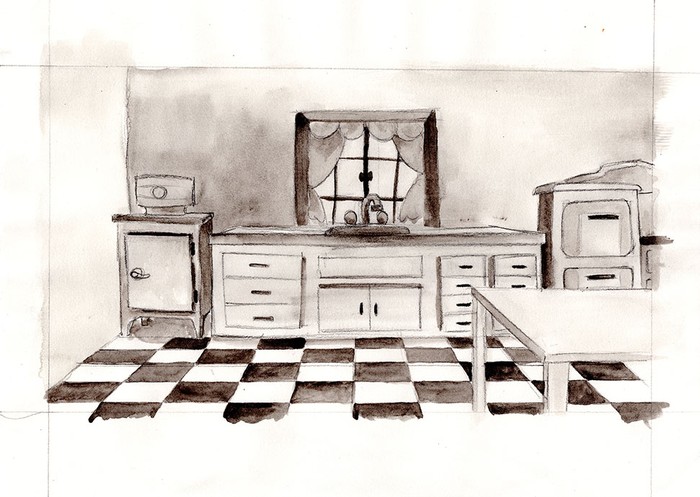
Every bit an animator, I learned a great deal nearly my craft from this project. Studying the precursors of our electric current digital techniques has given me a greater understanding of the procedure equally a whole. Turnarounds are tight and animation is yet labor-intensive, but today we are lucky to exist able to produce professional-quality animation relatively fast. Past practicing the techniques of the 1930s, I think I've actually sped up my workflow!
—Caitlin Cadieux
Can an Creative person Nevertheless Shape an Era?
Karen Yuan discusses why it may be difficult for another artist to have an affect as dandy as Picasso's.
When Pablo Picasso died in 1973, the painter Willem de Kooning said, "Certain artists are always with me, and surely Picasso is one of them." Since his first exhibition in America more than than a century ago, Picasso has shaped the imagination of American artists.
That commencement exhibit, at the photographer Alfred Stieglitz' New York gallery in 1911, shocked Americans with Picasso's intensely abstract Cubist works, which used geometric shapes to represent various perspectives at once. Information technology was a new vision in art for a new time—avant-garde fine art was rise to prominence alongside skyscrapers and jazz. The well-nigh innovative artists in America at the time began painting Cubist works, including Marsden Hartley, one of the pioneers of modernist American art.
/media/img/posts/2018/03/Screen_Shot_2018_03_21_at_2.26.29_PM/original.png)

After his second major exhibition in America, a forty-year retrospective of his work at the Museum of Modern Fine art, which took place in 1939, Picasso's bear upon on the art earth broadened amidst artists. Well-known by then, Picasso startled them again with new works, including Guernica, which responded to the Spanish Civil War. At the same time, World War Two was only kickoff. "The sheer violence and free energy of his work … Artists felt that it actually connected to what was happening in the world at that moment," said Michael FitzGerald, a Picasso scholar who curated the Whitney Museum'south 2006 exhibition on the artist's influence on American art.
The exhibition was vast compared to previous ones. The sculptor and painter Louise Conservative wrote in her diary:
In that location was an exhibition of 400 paintings by Picasso here (twoscore years' piece of work). Information technology was so beautiful, and information technology revealed such genius and such a collection of treasures that I did not selection up a paintbrush for a month. Consummate shutdown. I cleaned brushes, palettes, etc. and tidied everything … Once the source of joy disappeared, life became depressing.
Jackson Pollock covered up Picasso-inspired shapes with his baste paintings. A review of the Whitney exhibition in New York magazine said that, for artists, "[Picasso'due south fine art] embodied freedom, alter, and possibility." The modernist painter Stuart Davis, reaching back to Cubism, added a twist of jazz to it.


Picasso's influence echoed in American art throughout the second one-half of the 20th century. The typography in some of his Cubist work, and Guernica, with its newspapery, drawing-like look, influenced Pop artists like Andy Warhol and Roy Lichtenstein. In the 1980s, the chaos in the creative person Jean Michel Basquiat's paintings reflected the later work of Picasso—Basquiat even dedicated a few paintings to him. Today, said FitzGerald, "the artist who's had the greatest response to Picasso's work is George Condo," who created the surreal posters for Kanye West'due south anthology My Beautiful Nighttime Twisted Fantasy.


FitzGerald contends that few other artists have had the same pervasive impact on American art as Picasso. As for artists in the hereafter—"it's hard to imagine," he admitted, given the fragmentation of the gimmicky art world. In the 20th century, art had a geographic center, such as Paris or New York. Today, fine art has get globalized, with more artists and more ideas in more places. "It'southward much harder to accept a comprehensive sense of what artists are interested in," FitzGerald said. A style like Cubism may not have the same monolithic effect that it had in the past.
That fragmentation has been occurring since the 1970s—the same decade Picasso died. Later on that, said FitzGerald, "the sense of cohesiveness of statement really shattered, and it'southward never been put back together over again, and I don't retrieve it always will be." The absenteeism of a new champion in the art world may compound Picasso's enduring effect on it.
In 1923, Picasso wrote a statement to his friend Marius de Zayas, who helped organize that commencement exhibition at Stieglitz' gallery, on art's human relationship with fourth dimension. While he felt at that place existed periods of art more "complete" than others, he didn't believe in a past or future for art. "If a work of art cannot live always in the present, it must non exist considered at all," he said. "All I accept ever made was fabricated for the nowadays and with the hope that it will always remain in the present."
—Karen Yuan
Volition Today's Art Somewhen Await "Then 2018?"
We asked CityLab staff writer Kriston Capps to reverberate on how today's fine art will be seen past art enthusiasts of the future.
At that place's a lens effect in art: The more recently it was created, the harder it is to place. Fine art from the past falls into neat categories similar Bizarre or De Stijl, while contemporary fine art makes for hard sorting. Even the occasionally stable tentpoles for fine art of the 21st century, whether it'south post-blackness or social practice or zombie ceremonial, are built on the shifting sands of abiding art-world bickering.
Just the fact of the matter is that fine art from the past is bailiwick to greater revisionist pressure than the local museum may prove. Especially now, equally women artists and artists of color—or artists working outside the West—are finding buy in collections, exhibits, and scholarship, the canon is shifting. Meanwhile, art of the moment is usually quite easy to situate in one case the moment has passed. Recall of art in the terms that utilize to music and it might make more sense: Eventually, the bleeding-edge sound of alternative metal joined the ranks of archetype stone, then disappeared from the radio altogether in favor of pop music, which is today mostly the hip-hop sub-genre known as trap. Tomorrow information technology will sound similar something else.
Gimmicky art'southward no different: While it might seem like anything goes at art festivals today, give it plenty time and art, too, volition look distinctly '90s (Julian Schnabel), '00s (Julie Mehretu), and '10s (?).
—Kriston Capps
Today'south Wrap Up
-
Question of the Day: Will the art of today exist as piece of cake to date as the art of the past?
-
What'due south Coming: This calendar week marks the 15th anniversary of the Iraq State of war. On Fri, nosotros'll reflect on lessons learned since the start of the conflict.
-
Your Feedback: How are we doing? Have our survey below.
/media/img/posts/2018/03/imageedit_2_3181866120/original.png)
We want to hear what y'all retrieve near this article. Submit a letter to the editor or write to letters@theatlantic.com.


Karen Yuan is a former assistant editor at The Atlantic.
/media/None/Caitlin_Cadieux_grey/original.png)
Caitlin Cadieux is a one-time animator at The Atlantic.

Kriston Capps is a staff writer for CityLab roofing housing, architecture, and politics. He previously worked as a senior editor for Builder mag.
0 Response to "ââåage of Uncertaintyã¢ââ Reflected in the Arts of This Era?"
Post a Comment