The Original Idea of the Avant Garde as Applied to Art Was That It Would Prepare People for
Assuming, innovative, progressive, experimental—all words that describe art that pushes boundaries and creates change. These characteristics are as well all associated with a term that is oftentimes used but sometimes misconceived—avant-garde. The French term, which translates to "advance guard" or "vanguard," refers to something visionary and alee of its time.
Used often to discuss artistic contributions to society and culture, avant-garde is responsible for some of the most famous paintings and sculptures in history. But how does ane narrate advanced fine art? And who are the forward-thinking artists that took the risks that at present ascertain fine art history?
In terms of art, advanced is usually tied to some sort of aesthetic innovation—one that is ofttimes misunderstood or unaccepted in its own time. It's a concept that applies to those creatives who have pushed confronting mainstream ethics and, though it's often used in relation to modernism, in that location are plenty of celebrated artists whose work tin can be seen as advanced during their fourth dimension.
Before nosotros dive into some of the most well-known avant-garde artists and art movements, let's look at where the term comes from and how information technology took on its current meaning. Initially, it was used by the French military machine and referred to a modest group of troops that carried out reconnaissance ahead of the main army. Over the course of the 19th century, information technology began being applied to left-fly socialist thinkers and their calls for political reform. In fact, it was the influential French socialist Henri de Saint-Simon who start applied the term to art.
In an 1825 text, he grouped artists together with scientists and industrialists equally leaders of society that could guide people frontwards. From at that place, avant-garde was a term regularly applied to artists, with many citing the realism of Gustave Courbet equally a starting point. Afterward, many modern movements would come across the term practical, though one could easily say that earlier artists like Leonardo da Vinci or Caravaggio were certainly avant-garde by breaking with traditional art practices. Fifty-fifty the Italian Renaissance itself was an avant-garde movement for its attention to perspective and realism in a way that was unheard of previously.
Advanced Fine art Movements
While this is by no means an exhaustive list, here are some of the more memorable modernistic art movements in Western history that are considered avant-garde for breaking boundaries.
Impressionism
While Impressionist art may not seem avant-garde by gimmicky standards, the motion was revolutionary in its time. Rejected by the traditional Paris Salon, painters similar Claude Monet, Edgar Degas, and Pierre-Auguste Renoir favored landscapes and scenes of daily life over the accepted historical and mythological subjects. They too broke with tradition by moving out of the studio and painting en plein air.
Iconic Impressionist Paintings:
- Impression, Sunriseby Claude Monet
- Luncheon of the Boating Party by Pierre-Auguste Renoir
- Paris Street: Rainy Twenty-four hour period by Gustave Caillebotte
- Bank check out this list to see 15 famous Impressionist paintings.
Fauvism
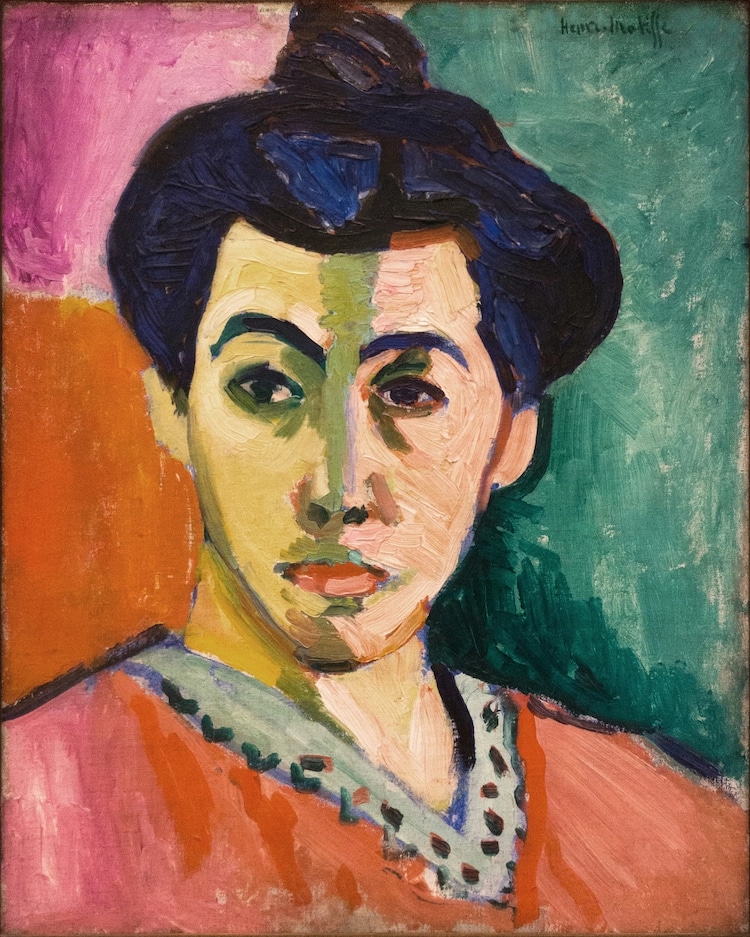
Henri Matisse, "Portrait of Madame Matisse. (The Green Line)," 1905 (Photo: Statens Museum for Kunst via Wikimedia Commons, Public domain)
Impressionism triggered a wave of innovative artists and styles. Amongst them was a cursory but powerful move chosen Fauvism. Co-founded by French artists Henri Matisse and André Derain, the mode of les Fauves , or "the wild beasts," is characterized past a saturated color palette, thick brushstrokes, and simplified—often almost abstracted—forms. Fauvism acted as a transitional period for many of the artists associated with it, nearly notably Matisse and Georges Braque. Following its conclusion in 1910, these figures used their Fauve experience to commence on new projects and enter new periods.
Iconic Fauvist Paintings:
- Portrait of Madame Matisse by Henri Matisse
- Adult female with a Hat by Henri Matisse
- Charing Cross Bridge past André Derain
Futurism
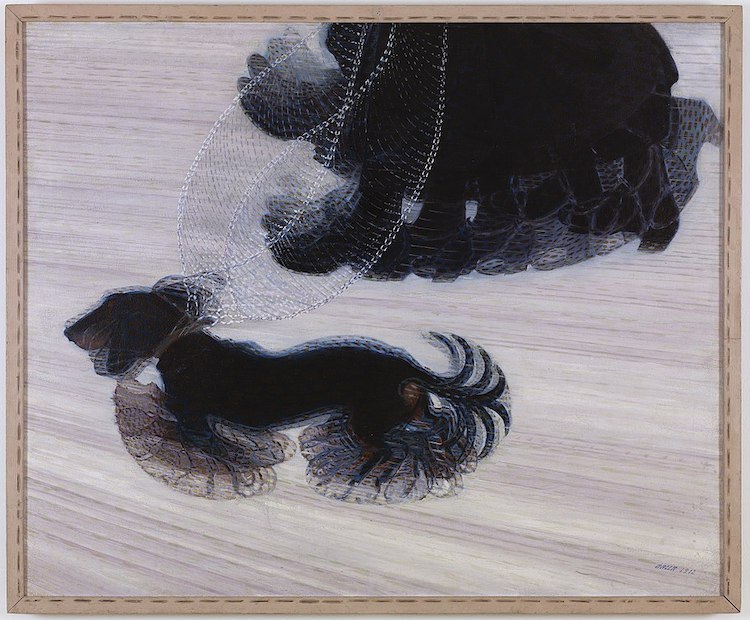
Giacomo Balla, "Dynamism of a Dog on a Ternion," 1912 (Photo: Wikipedia, Public domain)
Founded in 1909, Futurism was an avant-garde movement that embraced innovation, engineering, and transportation—all components of the time to come they saw after WWI. A hallmark of Futurist art is the depiction of speed and movement. In detail, they adhered to principles of "universal dynamism," which meant that no single object is carve up from its background or another object. Italian sculptor and leading futurist artist Umberto Boccioni explained the motion: "We synthesize every moment (time, place, form, color-tone) and thus paint the flick."
Iconic Futurist Art:
- Unique Forms of Continuity in Space by Umberto Boccioni
- Dynamism of a Dog on a Ternion by Giacomo Balla
Dada
Dada tin can exist a difficult motility to pivot down because the output of its artists is so various. It was formed in Switzerland during Earth War I and is revolutionary for its focus on making work that wasn't necessarily aesthetically pleasing. Its purpose, instead, was to question capitalist society and its values. Dada also made use of readymades—everyday objects appropriated equally pieces of fine art—as a way to question conservative sensibilities and the role of the creative person in creativity. Dada had a profound influence on other advanced movements that followed, like Cubism and Fluxus.
Iconic Dada Art:
- Fountain by Marcel Duchamp
- Glass Tearsby Homo Ray
- The Fine art Critic past Raoul Hausmann
Surrealism
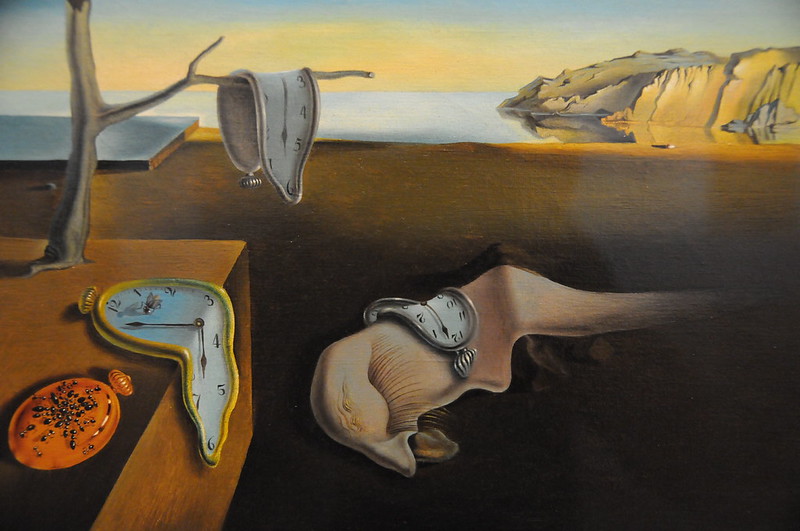 Surrealism is a highly experimental genre based on principles of the subconscious mind, borrowed from a literary technique called automatism. This suspension from reality gave Surrealist artists like René Magritte, Salvador Dalí, and Man Ray consummate artistic freedom, as they were no longer guided by academic principles. The dreamlike scenery of their art combines realistic renderings of fantastical subject field matter. Surrealists were besides well-known for dabbling in many forms of fine art, from painting and sculpture to photography and moving-picture show.
Iconic Surrealist Art:
- The Persistence of Memory by Salvador Dalí
- The Son of Manby René Magritte
- The Dandy Masturbatorby Salvador Dalí
Cubism

By completely abandoning traditional forms and moving toward abstraction, Cubism is one of the most well-known avant-garde movements. Founders Georges Braque and Pablo Picasso played with all the traditional, academic rules of Western art and transformed them into a new, unexpected method for creating art. Figures were broken into geometric shapes, colors were brightened and simplified, and collage was incorporated for an innovative issue that continues to shape fine art today. In fact, looking at a timeline of art history, Western visual civilisation can be split conspicuously into two pieces—before and after Cubism.
Of import Cubist Artworks:
- Les Demoiselles d'Avignon by Pablo Picasso
- Three Musiciansby Pablo Picasso
- Guernica by Pablo Picasso
- Nonetheless Life with Metronomeby Georges Braque
Fluxus
Taking shape in the 1960s and 1970s, Fluxus is an interdisciplinary motility that involved artists, designers, composers, and poets. Heavily influenced by Dada, members of Fluxus staged functioning art events that included noise music, poetry readings, time-based performances, and much more. Composer John Cage had a swell deal of influence in Fluxus and his notion that interaction between an artist and the audience was the most important phase of piece of work—rather than the finished product—was often followed. Avant-garde artists like Joseph Beuys, Yoko Ono, and Nam June Paik were all active in Fluxus.
Important Moments in Fluxus:
- Cut Pieceby Yoko Ono
- Zen for Moving-picture showby Nam June Paik
- Make a Saladpast Alison Knowles
This article has been edited and updated.
Related Manufactures:
13 Revolutionary Art Movements That Have Shaped Our Visual History
10 Great Hispanic Artists Who Shaped Western Culture
Why Post-Impressionist Painter Paul Cézanne Is Known as the "Father of Modernistic Art"
What is Modern Art? Exploring the Movements That Define the Groundbreaking Genre
Source: https://mymodernmet.com/avant-garde-art-definition/
0 Response to "The Original Idea of the Avant Garde as Applied to Art Was That It Would Prepare People for"
Post a Comment